

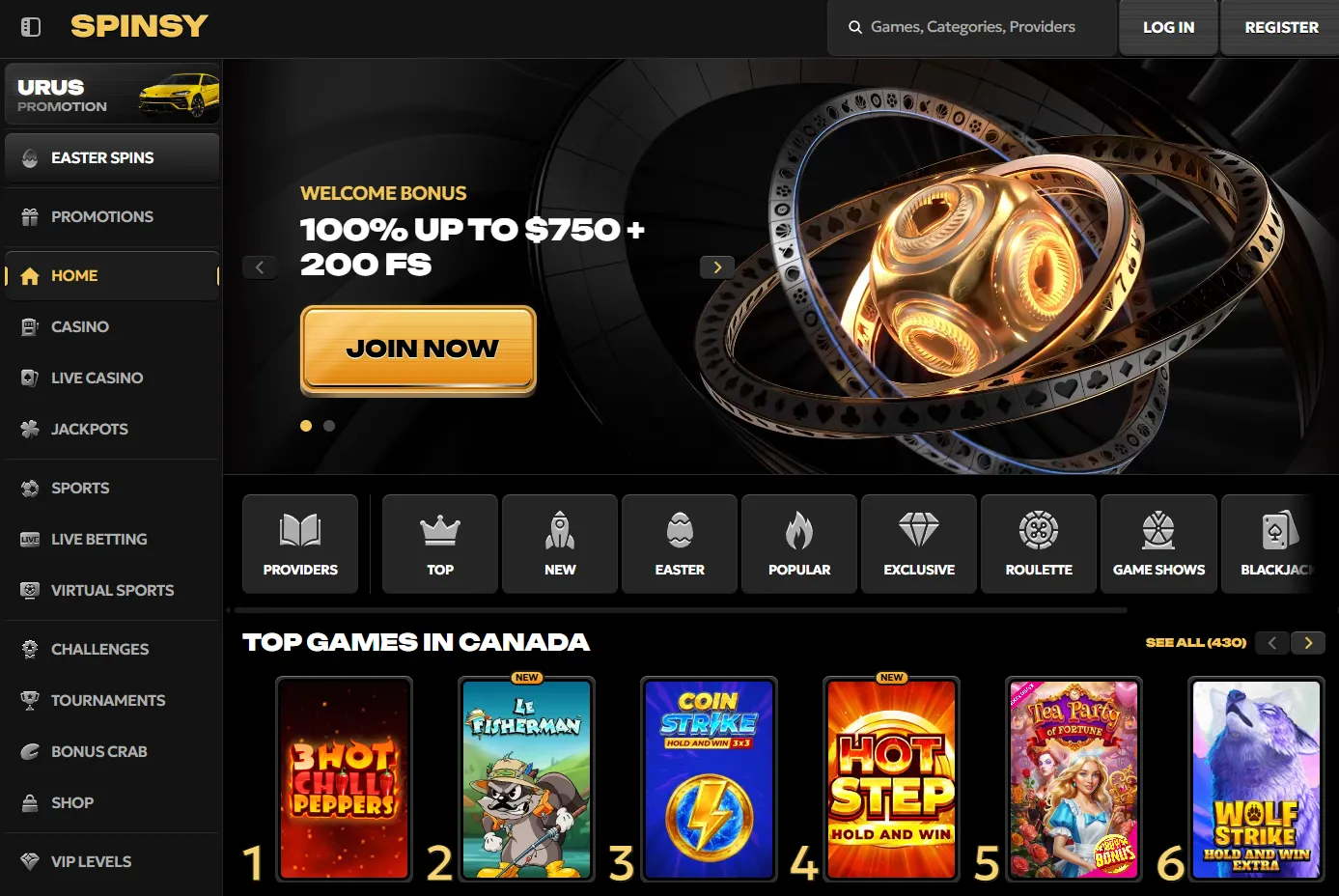
Choosing an online casino game is easier when the lobby helps you narrow the field instead of presenting thousands of titles at once. The Canadian-facing spinsy casino lobby combines search, categories and provider filters, with many games offering demo play. That creates a useful way to compare game formats before deciding which style best suits your time, preferences and comfort with uncertainty. The aim is not to predict results, but to make game discovery more deliberate and less overwhelming.
Start with the game format, not the title

The first useful choice is the type of experience you want. Slots are generally the simplest to browse: choose a title, review its information and spin. Instant games often use shorter rounds or compact mechanics, while table games recreate familiar formats such as roulette, blackjack and baccarat. These categories can feel very different even when they appear beside one another in the same lobby, so deciding on a format first can reduce aimless scrolling.
Live casino adds a streamed table and a human dealer, which may appeal to players who prefer a more social presentation. The available live sections include roulette, blackjack, baccarat and dice, along with poker, international tables and game-show-style titles. Game shows such as Crazy Time, Mega Ball and Deal or No Deal use a television-inspired format, but they should still be approached as games of chance rather than entertainment with predictable outcomes.
Jackpot games deserve a separate mental category because their attraction often centres on a large possible prize rather than a particular theme or mechanic. Their prize structures and conditions can differ from ordinary slots, so read the game information before playing. If you are undecided, use the lobby’s broad categories first, then compare a small number of titles instead of opening every result. A short, focused shortlist is usually more useful than a long collection of unexamined options.
How can filters make a large lobby manageable?
A searchable lobby is most useful when you combine several filters in a logical order. Begin with the broad category—such as Slots, Table Games, Live Games or Instant Games—then narrow by a provider if you already recognize a studio’s style. The Canadian lobby also includes groupings such as Top, New, Popular, Exclusive and jackpots. These labels can help with orientation, but they do not establish that a game is better or more likely to win.
Provider filters are particularly useful for returning to a familiar visual style or game mechanic. The directory includes studios such as Hacksaw Gaming, Amusnet, BGaming, Booongo, Spinomenal, Yggdrasil, Amatic, Oryx, Evoplay and CT Interactive, among many others. Other catalogues associate the platform with larger names including Pragmatic Play, Play’n GO, NetEnt, Red Tiger, Relax Gaming, Nolimit City, Playtech and Evolution. Treat provider names as navigation tools, not quality guarantees.
Search can also be more precise than browsing a category. Try a game title, a theme, a provider or a format, then remove filters when results become too narrow. If a title appears in more than one section, that usually reflects categorization rather than a different version of the game. Before choosing, open the information panel and check the rules, available features and any displayed statistical details. A filter helps you find a game; it does not replace reading what that game actually does.
When is demo play useful—and when is it limited?
Demo play can be a practical screening tool when it is available. It lets you see whether the pace, interface, sound and bonus features suit your preferences without immediately committing funds. For a slot, a few sample rounds may reveal whether the controls are clear and whether the animations are distracting. For a table game, demo access can help you understand the layout and sequence of a round.
However, short demo sessions cannot establish how often a game will pay, how volatile it is over the long term or whether a particular outcome is “due”. Random results remain random, and a brief sequence can look unusually generous or unusually poor by chance. Demo outcomes may also be presented under conditions that do not exactly match real-money play, so check the game’s displayed rules rather than assuming the modes are identical.
Use demo play as a compatibility check, not a test of profitability. A sensible review process is to examine the instructions, try the controls, note the pace and stop if the game is not enjoyable or understandable. You can also compare several games in the same category rather than forming a conclusion from one title. This approach keeps the focus on informed selection instead of treating a small sample of results as evidence about future performance.
What should be compared between similar games?
When two titles look alike, compare their mechanics rather than their artwork. For slots, look at the number of reels or ways to win, the presence of bonus rounds, wilds, scatters and other features, and the way wins are displayed. For table games, compare the available variants, table rules and betting choices. In live games, consider the table format, pace, language or interface options shown in the lobby and whether the presentation is comfortable to follow.
Statistical information can provide context, but it should be interpreted carefully. If a game displays an RTP figure, that is a long-run theoretical percentage, not a personal forecast for a short session. Volatility is also a broad description of how results may be distributed over time, not a promise of frequent wins or a specific payout pattern. Neither measure makes one game suitable for every player.
Practical details matter too. Check whether the title works smoothly on your browser and device, whether the text is readable and whether the rules are available before play. A responsive mobile website can make browsing convenient, but a smaller screen may make detailed rules or live-table information harder to examine. If a game loads slowly, feels confusing or encourages hurried decisions, choosing another title is a reasonable trade-off even when its theme is appealing.
How should you build a small, sensible shortlist?
A shortlist can include one or two titles from each format that interests you: perhaps a standard slot, an instant game, a table game and a live option. This makes comparison easier than moving randomly through the full catalogue. Record the title, provider, format and any notable rules in your own notes. The exercise is not about identifying a guaranteed winner; it is about finding games whose design and pace you understand.
Next, remove anything that does not match your preferences or requires assumptions you cannot verify. A jackpot title may be unsuitable if you dislike large prize-focused mechanics. A live table may not fit if you prefer quick, private rounds. A complex slot may be frustrating if you want straightforward play. Being selective is not missing out; it is a way to prevent a large catalogue from dictating your decisions.
Finally, decide in advance how long you intend to browse and what information you need before choosing. Keep promotional conditions separate from the game’s ordinary rules, since a bonus can impose additional requirements that do not change the underlying mechanics. If play stops being enjoyable or begins to feel difficult to control, leave the lobby rather than switching formats in search of a different result. Good discovery ends with a clear choice—or with the decision not to play.
Game-discovery questions readers often ask
Are popular games more likely to win?
No. Popular, new or featured labels describe how games are presented or browsed, not the probability of a particular result. Each game should be assessed through its own rules and displayed information. A title’s position in a lobby cannot establish that it has better odds, higher payouts or a more favourable outcome.
Does a provider name guarantee a certain experience?
No. A provider can help you locate familiar design styles, but games from the same studio may use different mechanics, volatility and interfaces. Read each title’s instructions separately. Treat provider filters as a convenient discovery feature rather than evidence that every game from that studio will suit your preferences.
Should I choose slots, table games or live casino first?
Choose according to the experience you want, not a belief that one category is more reliable. Slots are usually quick to browse, table games offer recognizable rules and live casino adds streamed presentation. Compare the instructions, pace and interface, then select only a format you understand and can approach comfortably.